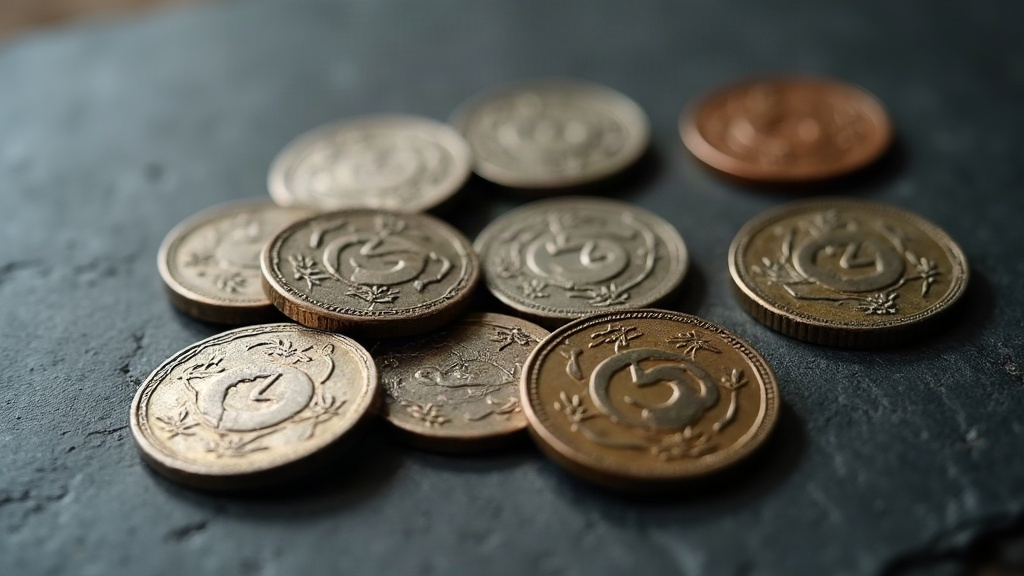
Indian coinage spans more than 2,500 years, moving from hand-struck punch-marked silver to the decimal rupee used today. Empires rose and fell, and each left a distinct monetary fingerprint. The chapter most collectors overlook involves roughly 565 princely states that kept minting their own coins under British oversight, well into the 20th century. For identification purposes, a coin’s origin state often matters more than its era.
The Earliest Indian Coins
India’s coined money history begins around the 6th century BCE. The earliest pieces are known as punch-marked coins, made of silver or copper. Artisans struck them with small dies showing symbols rather than portraits or script. Suns, trees, and animal figures recur across these early issues. No single authority controlled production, so designs varied sharply by region and workshop.
Mauryan and Gupta Coinage
The Mauryan Empire, roughly 322 to 185 BCE, brought the first broadly unified coinage to the subcontinent. Later, the Gupta Empire (approximately 320 to 550 CE) issued finely detailed gold coins called dinars. These showed kings, deities, and inscriptions in Brahmi script. The craftsmanship on Gupta gold is still cited as a high point of ancient Indian minting. The Smithsonian Institution holds examples of this period in its numismatic collections.
The Mughal Rupee and a Lasting Standard
The Mughal Empire ruled from 1526 to 1857. During the mid-1500s, the administrator Sher Shah Suri introduced a standardized silver coin called the rupia. It weighed close to 11.6 grams and was struck near 91.7% fine silver. That weight and purity standard outlasted the Mughals themselves. It shaped coinage across much of India for centuries afterward, including under later British rule.
British Company and Crown Issues
The British East India Company began issuing its own coins in the 1700s. After the 1857 uprising, the British Crown took direct control of India in 1858. Crown-era rupees carried the monarch’s portrait and English inscriptions alongside local scripts. These coins circulated widely and are common finds today. Readers exploring this period in depth may find our overview of British Empire-era coins useful background.
The Real Puzzle: India’s Princely States
This is where the standard timeline breaks down, and where most introductions stop too soon. Britain did not rule all of India directly. Roughly 565 princely states retained internal sovereignty under treaties of paramountcy, and many kept the right to strike their own coins. Each durbar, or ruling court, ran its own mint, chose its own script, and often kept its own metal standard. The result is a patchwork of currencies that circulated alongside the British India rupee until the states acceded to the new Indian Union between 1947 and the early 1950s.
For a collector, this changes the identification problem entirely. A coin’s date and a general sense of “Mughal” or “British colonial” tell you less than which state struck it. Script, ruler titles, denomination names, and metal fineness are state-specific, and misreading any of them leads to a wrong attribution. The table below outlines a few well-documented examples.
| State | Script / Language | Distinct Denomination | Identifying Feature |
|---|---|---|---|
| Hyderabad | Persian / Urdu | Hali Sicca, later Osmania Sicca rupee | Nizam’s titles, own mint marks distinct from British India issues |
| Travancore | Malayalam | Chuckram, cash | Conch shell (sankha) as the state emblem |
| Kutch | Kutchi / Devanagari | Kori (silver) | Dagger and sun motifs unique to the Jadeja rulers |
| Baroda | Devanagari | Rupee, similar weight to British standard | Gaekwad ruler’s name and separate mint mark |
Notice the variety even in this short list. Some states used familiar rupee-based systems; others kept older cash and chuckram denominations unrelated to British decimal thinking. Some struck in silver close to the imperial standard; others used lighter or more debased alloys for local trade. A coin’s metal content is a technical fact worth checking, much like the purity questions covered in our piece on hallmarks and assay marks. Scarcity also varies enormously by state, since mint output, war damage, and later melting for bullion differed from court to court. That is a key reason two coins from the same decade can have very different rarity, a distinction explored further in our general guide to what makes a date or issue genuinely scarce.
Because these issues are less standardized than British India coinage, they are also more commonly misattributed, whether through honest error or less honest sales pitches. A seller claiming a princely state coin is extraordinarily rare, without pointing to verifiable mint records, is a reasonable moment to pause. Legitimate dealers do not need pressure tactics to make a sale, and a second opinion before a significant purchase is always a reasonable step.
Independence and the Modern Rupee
India became independent in 1947, and most princely states joined the Indian Union soon after. Their separate mints were phased out over the following years. The Republic of India adopted the decimal rupee system in 1957, replacing the older anna-based subdivisions. Modern Indian coinage is issued through government mints and documented by the Reserve Bank of India.
Where This Fits for Collectors
Indian coins, ancient through princely, fall under the broader world of world and ancient coins, a category with its own identification habits worth learning before buying. Our coin collecting guide covers the basics of handling, storing, and researching unfamiliar issues like these. And because bullion content and collector interest do not always move together, it helps to understand the difference described in our article on numismatic value versus bullion value before assuming any old coin is worth more than its weight in metal, or less.
Frequently asked questions about Indian coinage history
What is the oldest type of Indian coin?
The oldest widely recognized Indian coins are punch-marked pieces of silver and copper, dating to roughly the 6th century BCE. They carry struck symbols rather than writing or portraits, and designs vary by region since no single authority controlled early production.
Why did princely states have their own coins?
Under British paramountcy, many Indian princely states kept internal self-rule through treaties, which included the right to mint currency. Roughly 565 such states existed before 1947, each running its own mint, script, and sometimes its own denominations alongside the British India rupee.
How do I tell which state minted an old Indian coin?
Check the script, the ruler’s name or title, and the denomination name, since these are usually state-specific. Reference books and museum collections covering princely state issues are the most reliable way to confirm an attribution before assuming rarity or value.
Is the Mughal rupee the same as the modern Indian rupee?
They share a name and a historical lineage, but not a design or standard. The Mughal-era rupee was a silver coin near 91.7% fine silver and about 11.6 grams. The modern rupee is a decimal currency issued by the Republic of India since 1957.
Are princely state coins rare or valuable?
It depends heavily on the specific state, mint, metal, and condition, not just the fact that it predates independence. Some states struck large quantities; others very little. A current appraisal from a qualified, reputable source is the only reliable way to assess a specific piece.
When did India stop using separate princely state coins?
Most princely states acceded to the Indian Union shortly after 1947, and their individual mints were phased out over the following years as the country moved toward a unified currency, culminating in full decimalization of the rupee in 1957.
Gold Coins Today publishes general information about coin collecting and precious metals, not financial, investment, tax or legal advice. This article was drafted with AI assistance and is not written or reviewed by certified numismatists, appraisers, financial advisors or dealers. Coin and bullion values change constantly and depend on condition, authenticity and the current market — get a current appraisal or spot price from a qualified, reputable source before buying or selling, and consult a licensed financial advisor before treating precious metals as part of an investment strategy.
How this article was made. It was drafted with AI assistance and published after automated checks. It has not been checked line by line against primary sources; articles that have been say so in a dated note. See our editorial policy.