
Common coin abbreviations you’ll see online fall into a few groups: grading terms (MS, AU, VF, PR), coin-part shorthand (OBV, REV, MM), marketplace and forum slang (BIN, NIB, OBO), and organization initials (PCGS, NGC, ANA). Most are simply shorter ways to describe condition, features, or where a coin has been certified. Learning a few dozen of the most common ones makes listings, auction descriptions, and forum threads far easier to read.
Coin abbreviations exist mostly because listings, forum posts, and slab labels have limited space. Sellers on auction sites and dealer boards compress terms like “brilliant uncirculated” into “BU” or “double die obverse” into “DDO” as a kind of shared shorthand. If you’re new to the hobby, this alphabet soup can look intimidating, but almost all of it maps back to concepts covered in a basic coin collecting guide — condition, mint marks, coin parts, and certification.
Grading and condition abbreviations
Grading abbreviations describe how much wear a coin shows and, for proof coins, how it was struck. They’re often paired with a numeric grade (for example, “MS63” or “AU55”) under the Sheldon scale used by major grading services. A separate article on this site walks through what MS, AU, and XF actually mean in more detail if you want the full breakdown.
| Abbreviation | Meaning | General idea |
|---|---|---|
| MS | Mint State | Never circulated; graded on a numeric scale for surface quality |
| AU | About Uncirculated | Very light wear, close to mint condition |
| XF / EF | Extremely Fine | Light wear on high points, design still sharp |
| VF | Very Fine | Moderate wear, most detail still visible |
| F | Fine | Noticeable wear, major features still clear |
| VG | Very Good | Heavy wear, outline of design remains |
| G | Good | Well worn; date and major devices may be weak |
| PR / PF | Proof | Specially struck coin, usually for collectors, not general circulation |
| BU | Brilliant Uncirculated | No wear, retains original mint luster |
| UNC | Uncirculated | General term for a coin never used in commerce |
One term deserves a caution: AG is ambiguous. In grading it means “About Good” (a heavily worn coin), but on precious-metals sites AG is also the chemical symbol for silver. Context matters, and it’s worth reading the full listing rather than assuming which meaning applies.
Coin-part and feature abbreviations
These describe where on the coin something appears, which is useful when identifying date placement, mint marks, or die varieties, a skill covered more fully in a guide on reading the date and mint mark on a US coin.
| Abbreviation | Meaning |
|---|---|
| OBV | Obverse (front, “heads” side) |
| REV | Reverse (back, “tails” side) |
| MM | Mint mark, the small letter showing which US Mint facility struck the coin |
| DDO | Doubled Die Obverse, a specific type of die-produced doubling on the front design |
| DDR | Doubled Die Reverse, the same effect on the back design |
| RPM | Repunched Mint Mark, where the mint mark punch was applied more than once slightly off-register |
| VAM | A cataloging system (named for researchers Van Allen and Mallis) used mainly for Morgan and Peace dollar varieties |
| FS | Full Steps, a strike-quality designation used on certain nickels |
| FH | Full Head, a similar strike-quality designation used on certain quarters |
Terms like DDO, RPM, and VAM point toward the broader subject of coin varieties and errors, which is worth exploring separately if a listing description leans heavily on this vocabulary — it can affect how a coin is described and priced relative to a standard example, though it doesn’t change how carefully you should verify the claim yourself.
Certification and organization abbreviations
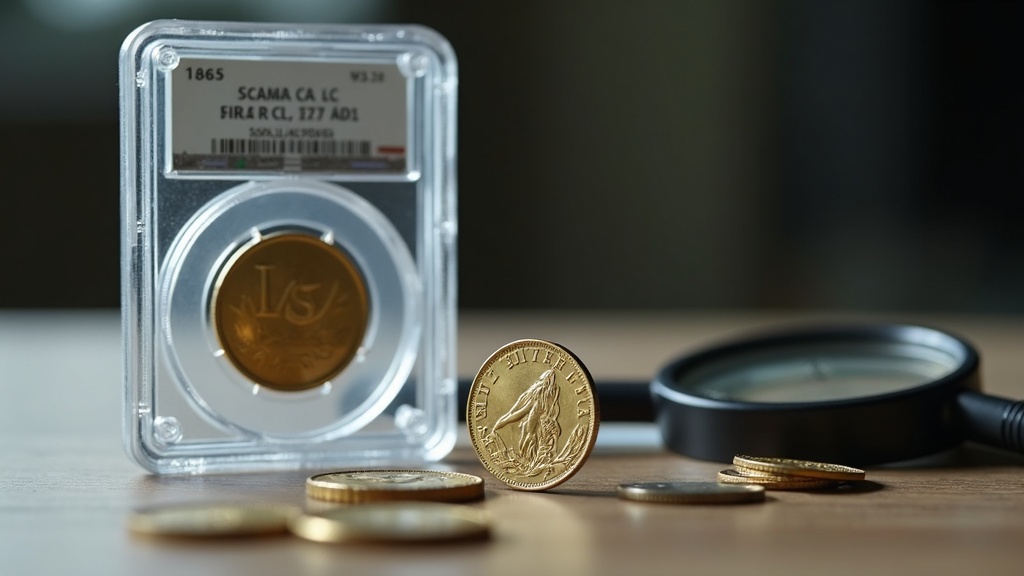
Slabbed, or professionally encapsulated, coins carry abbreviations for the service that certified them. Understanding these helps when comparing listings, and it’s covered in more depth in an article on what slabbing a coin means and why collectors do it.
| Abbreviation | Meaning |
|---|---|
| PCGS | Professional Coin Grading Service, a third-party grading company |
| NGC | Numismatic Guaranty Company, another major third-party grading company |
| ANACS | One of the older US third-party grading services |
| ANA | American Numismatic Association, an educational nonprofit organization for collectors |
| TPG | Third-Party Grader, a general term for any independent grading company |
| CAC | Sticker service that some collectors use as an additional opinion on a coin already graded by a TPG |
| COA | Certificate of Authenticity, a document (not a guarantee) accompanying some coins or sets |
It’s worth noting that a certificate or slab label is a claim about the coin, not proof on its own — a topic explored further in an article on what documentation should accompany a graded coin, and in another on what certificates of authenticity actually prove and don’t prove.
Marketplace and forum shorthand
Beyond grading terms, online listings and forum posts use general e-commerce abbreviations that aren’t coin-specific but show up constantly in the hobby.
- BIN — Buy It Now, a fixed-price purchase option on an auction listing
- OBO — Or Best Offer, meaning the seller will consider offers below the listed price
- NIB — New In Box, describing unopened original packaging (mostly for sets or supplies)
- PL — Prooflike, a surface quality term sometimes used for Morgan dollars and similar coins with unusually reflective fields
- DCAM / CAM — Deep Cameo / Cameo, describing frosted design elements contrasting with mirror-like fields on proof coins
- OGH — Old Green Holder, a nickname collectors use for an earlier style of PCGS holder
These terms come up constantly if you spend time on forums or auction sites, and a general primer on this kind of language is covered in a broader coin collecting terminology guide. If you’re browsing marketplaces regularly, it’s also worth reading a separate guide on what to know before buying coins online, since abbreviation-heavy listings sometimes obscure important condition details rather than clarify them.
A note on ambiguity and pressure tactics
Abbreviations are convenient, but they can also be used to make a coin sound more impressive than it is, or to gloss over problems like cleaning or damage. A listing that leans heavily on grading jargon without clear photos, a named grading service, or a straightforward description is worth a closer look. This is doubly true if you’re being pushed to decide quickly — legitimate dealers generally don’t use high-pressure tactics, and getting a second opinion or an independent look at a coin before a large purchase is a reasonable step, not an overreaction. Broader background on evaluating sellers is available in the site’s archive on buying and selling, and a related article on how to evaluate a coin dealer’s reputation covers similar ground.
Frequently asked questions about coin abbreviations
What does BU mean on a coin listing?
BU stands for Brilliant Uncirculated, describing a coin that has never circulated and still shows its original mint luster without wear. It’s a general condition description rather than a numeric grade, so it’s often paired with more specific grading language on certified coins.
What is the difference between MS and AU on coins?
MS (Mint State) describes a coin with no wear from circulation, graded on a numeric scale. AU (About Uncirculated) describes a coin with only the slightest trace of wear on its highest points, just short of full Mint State condition.
What does OBV and REV mean on a coin?
OBV is short for obverse, the front or “heads” side of a coin, while REV means reverse, the back or “tails” side. These terms are used to describe exactly where a feature, mint mark, or flaw appears.
What does PCGS and NGC stand for?
PCGS stands for Professional Coin Grading Service and NGC stands for Numismatic Guaranty Company; both are independent third-party companies that examine, grade, and encapsulate coins in protective holders known as slabs.
What does DDO mean in coin collecting?
DDO stands for Doubled Die Obverse, a variety where the coin’s front design shows visible doubling because of how the die used to strike it was made. A similar term, DDR, refers to the same effect on the reverse side.
Gold Coins Today publishes general information about coin collecting and precious metals, not financial, investment, tax or legal advice. We are writers and editors, not certified numismatists, appraisers, financial advisors or dealers. Coin and bullion values change constantly and depend on condition, authenticity and the current market — get a current appraisal or spot price from a qualified, reputable source before buying or selling, and consult a licensed financial advisor before treating precious metals as part of an investment strategy.