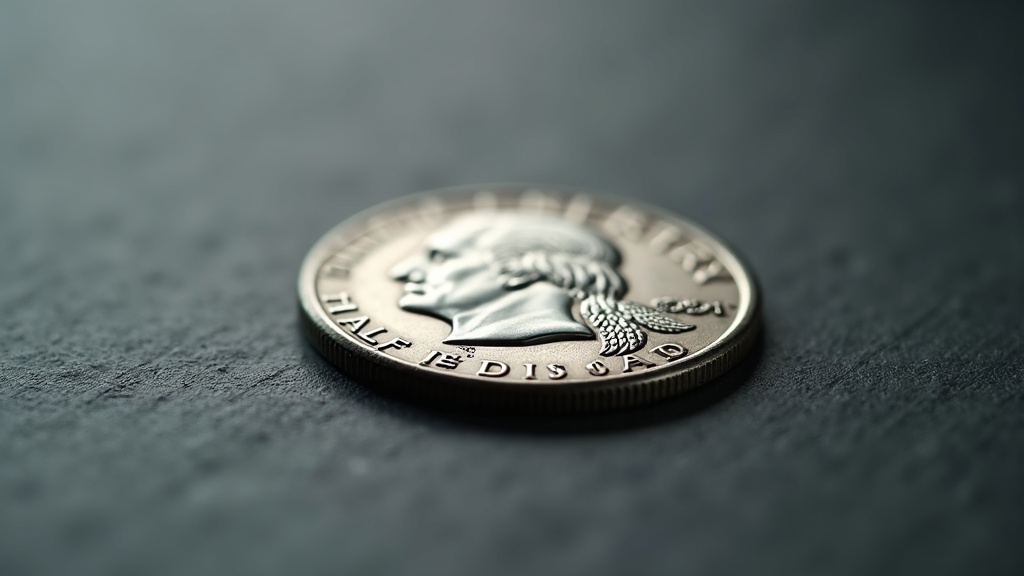
A Franklin half dollar is a 90% silver US coin minted from 1948 to 1963, featuring Benjamin Franklin on the obverse and the Liberty Bell on the reverse. Its value as a collectible depends on date, mint mark, condition, and whether the delicate “bell lines” on the reverse remain sharp, while its silver content gives it a separate bullion-based worth tied to the current market. Understanding both sides of that equation helps a collector make sense of what they’re actually holding.
This guide walks through where the design came from, what to look for on the coin itself, and the factors that experienced collectors weigh when evaluating a Franklin half dollar — without pretending to hand you a price tag, since real values shift with the market and depend on a coin actually being examined in hand.
Where the Franklin half dollar came from
The Franklin half dollar replaced the Walking Liberty half dollar in 1948, a design change pushed forward largely by Nellie Tayloe Ross, then Director of the US Mint, who admired Benjamin Franklin and felt he deserved a place on US coinage. If you want to compare the two designs directly, the earlier series is covered in our guide to the Walking Liberty half dollar, which shares the same denomination but a very different look and feel.
The Franklin half dollar was designed by Mint sculptor-engraver John R. Sinnock, who had also created the Roosevelt dime. Sinnock based Franklin’s portrait loosely on earlier busts and paintings of the statesman, and paired it with a reverse depicting the Liberty Bell, with a small eagle added beside the bell to satisfy a legal requirement that half dollars carry an eagle design element. The series ran for sixteen years before being discontinued after 1963, replaced in 1964 by the Kennedy half dollar following President Kennedy’s assassination — a change made quickly out of public sentiment rather than any flaw in Franklin’s design.
Design features worth knowing
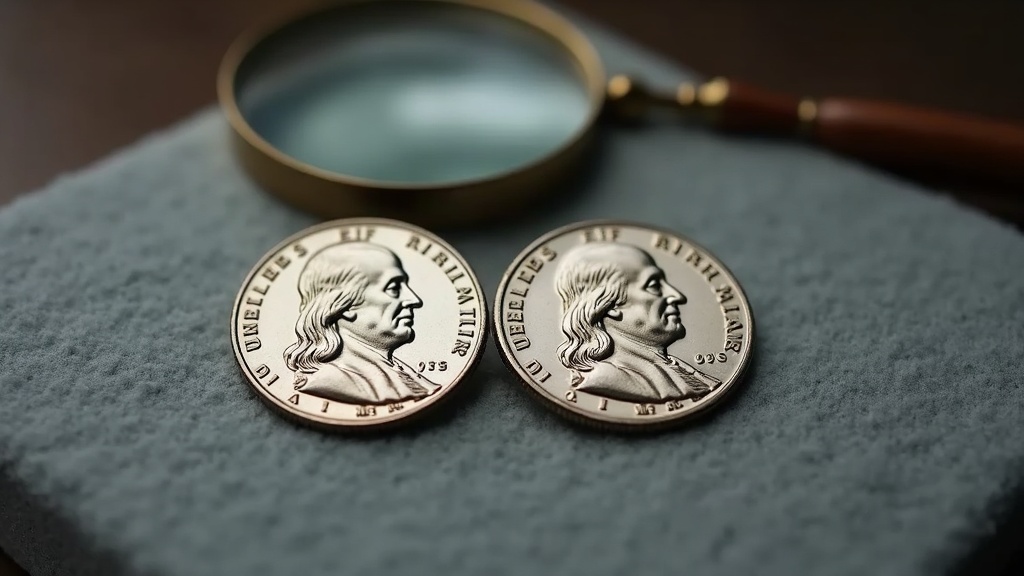
On the obverse, Franklin’s portrait faces right, with “LIBERTY” arched above and “IN GOD WE TRUST” to the left of his image. The reverse shows the Liberty Bell in the center, a small eagle to its right, and “UNITED STATES OF AMERICA” and “HALF DOLLAR” around the rim. Below the bell, a thin crack is rendered as part of the design — that’s simply how the real Liberty Bell appears, not a minting flaw.
Collectors pay particular attention to the horizontal lines at the base of the bell, commonly called “bell lines.” On a well-struck, lightly circulated coin, these lines appear crisp and fully separated. On a coin that has seen wear, or one that was struck with worn dies, the lines can look blurred or partially merged. Because bell lines are one of the first details to soften with wear, they’re a quick visual reference point when comparing the condition of two coins side by side, even before getting into formal grading.
Reading the date and mint mark
Franklin half dollars were struck at the Philadelphia, Denver, and San Francisco mints. Coins from Philadelphia carry no mint mark, while Denver coins are marked “D” and San Francisco coins are marked “S.” The mint mark sits on the reverse, above the bell and just to the left of the crack. If you’re new to locating this kind of detail, our general walkthrough on how to read the date and mint mark on a US coin covers the same logic that applies here.
The date appears on the obverse, below Franklin’s portrait. Because these coins are now several decades old, dates can wear down on heavily circulated examples, so a coin found in pocket change or an old collection may need a loupe or magnifying glass to confirm the exact year and mint.
What shapes a Franklin half dollar’s condition and appeal
As with most series struck for circulation, several factors combine to determine how a given Franklin half dollar is regarded by collectors:
- Mintage figures. Some dates and mint marks were produced in far smaller numbers than others, and lower-mintage issues tend to draw more collector interest. Our explainer on what makes a coin a “key date” goes into how mintage and survival rates interact to create these standout dates within a series.
- Strike quality and bell lines. Coins with sharp, fully separated bell lines — sometimes labeled “Full Bell Lines” by third-party grading services — are generally viewed as a step above otherwise similar coins that lack that detail.
- Surface preservation. Original luster, absence of scratches or heavy toning issues, and lack of damage all factor into where a coin lands on the grading scale.
- Authenticity and originality. A coin that has been cleaned, re-toned, or altered is typically valued differently than one left in its natural state, which is why learning to spot cleaning matters before assuming a shiny coin is simply “well preserved” — our piece on how to tell if a coin has been cleaned walks through the common signs.
Grading a Franklin half dollar
Franklin half dollars are graded on the same numeric Sheldon scale used across US coinage, running from heavily worn examples up through pristine mint-state pieces. If you’re unfamiliar with how that scale works or what the abbreviations mean, our guide to the Sheldon coin grading scale breaks down the full range in plain terms. Because grading is a specialized skill involving subtle differences in wear, luster, and strike, many collectors choose to send meaningful coins to a professional third-party grading service rather than rely solely on their own eye, particularly for coins being bought or sold at a distance.
It’s worth remembering that grading and value are related but not identical — a coin’s grade is one input among several, alongside date, mint mark, and demand, that goes into how it’s ultimately regarded in the market.
Silver content and how it fits into the picture
Every Franklin half dollar was struck in 90% silver, the same standard used for US dimes, quarters, and half dollars of that era before the switch to clad coinage in the mid-1960s. That silver content means these coins carry a bullion-related component to their value in addition to any numismatic premium tied to date, condition, or rarity. Because silver prices move continuously, the only way to understand what a specific coin’s metal content translates to at any given moment is to check a current, live spot price from a reputable source rather than rely on a fixed figure, which would be outdated almost immediately.
Building or evaluating a set
Some collectors pursue a complete date-and-mint-mark run of Franklin half dollars, while others simply pick up a few representative pieces to appreciate the design and history. Either way, proper storage matters: coins handled carelessly or stored in low-quality holders can develop scratches, PVC haze, or other damage that affects both appearance and long-term condition. Our comparison of coin albums, folders, and holders is a useful starting point for deciding how to house a growing set.
If you’re newer to the hobby generally, browsing our US coins and history hub is a good way to see how the Franklin half dollar fits alongside other series from the same era, and how mid-20th-century US coinage evolved leading up to and after the 1965 shift away from silver.
A note on sales pressure
Franklin half dollars, like many silver coins, are sometimes used as a hook in high-pressure sales pitches, particularly ones built around urgency about the dollar or the economy. A legitimate coin dealer or numismatic professional generally doesn’t need to rush a buyer into a decision. If you’re ever presented with a Franklin half dollar — or any coin — as part of a time-limited offer or an emotionally charged pitch, it’s entirely reasonable to slow down, ask questions, and seek an independent appraisal or a second opinion before making a purchase of any size.
Frequently asked questions about Franklin half dollars
How can I tell if my Franklin half dollar is silver?
All Franklin half dollars struck for circulation between 1948 and 1963 are 90% silver, so if you have a genuine example from that date range, it contains silver by default; no separate testing is needed unless authenticity itself is in question.
What is the difference between a Franklin half dollar and a Walking Liberty half dollar?
They’re different half-dollar designs from different eras — Walking Liberty ran from 1916 to 1947 and depicts Liberty striding forward, while the Franklin half dollar followed from 1948 to 1963 with Benjamin Franklin’s portrait and the Liberty Bell.
Why do some Franklin half dollars say “Full Bell Lines”?
“Full Bell Lines” is a designation some grading services apply when the horizontal lines at the base of the Liberty Bell on the reverse are fully struck and separated, which reflects strike quality rather than the coin’s overall wear level.
Are Franklin half dollars rare?
Most dates are common enough to be readily available to collectors, but certain date-and-mint-mark combinations had lower mintages and are considered more scarce; checking a specific coin’s mintage and condition is the only reliable way to gauge its standing.
How do I know if my Franklin half dollar has been cleaned?
Cleaned coins often show unnatural shine, fine hairline scratches across the surface, or an inconsistent look compared to the coin’s fields and devices; our guide on spotting cleaned coins outlines the visual clues in more detail before you draw conclusions.
Gold Coins Today publishes general information about coin collecting and precious metals, not financial, investment, tax or legal advice. We are writers and editors, not certified numismatists, appraisers, financial advisors or dealers. Coin and bullion values change constantly and depend on condition, authenticity and the current market — get a current appraisal or spot price from a qualified, reputable source before buying or selling, and consult a licensed financial advisor before treating precious metals as part of an investment strategy.