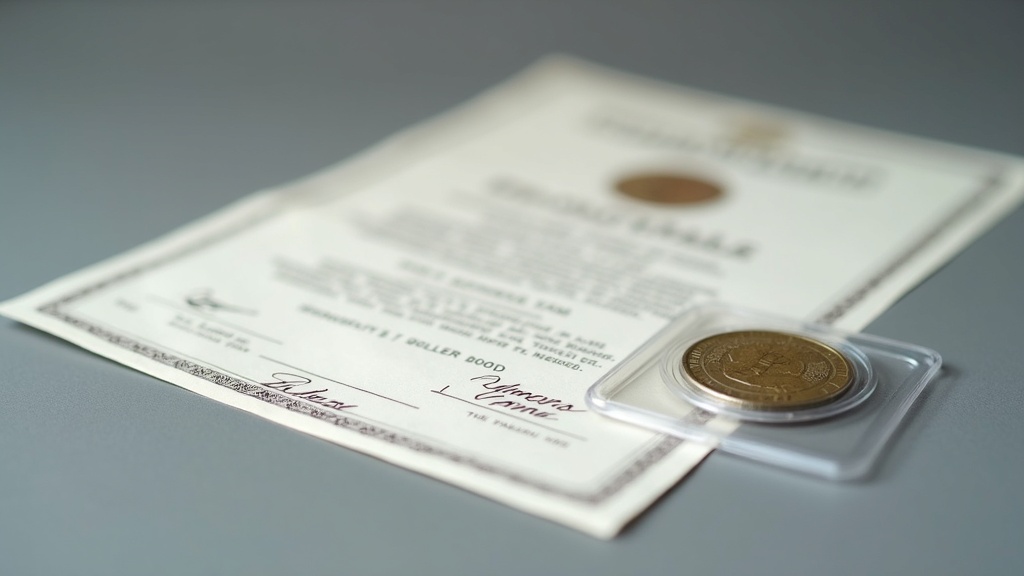
A certificate of authenticity is a paper or card issued by a seller, mint, or third party stating that an item is genuine and describing basic facts about it. On its own, it proves only that someone made that claim — it does not independently verify grade, condition, or current market value, and its reliability depends entirely on who issued it and how it was produced. Understanding what these certificates can and cannot do is essential before treating one as proof of anything.
What a certificate of authenticity actually is
At its simplest, a certificate of authenticity (often abbreviated COA) is a statement of origin or genuineness. Government mints sometimes issue them with commemorative products, private mints include them with limited-edition medals or bullion rounds, and individual dealers may print their own for coins they sell. The format varies enormously: some include serial numbers that match a marking on the item itself, some carry the issuer’s letterhead and signature, and others are little more than a generic card with blank spaces filled in.
The key distinction to keep in mind is that a COA is a claim, not an examination. It tells you what the issuer asserts about the item. It does not, by itself, tell you that a qualified third party independently tested the metal, weighed the piece, or compared it against known genuine examples. That distinction matters a great deal when you’re deciding how much weight to put on the document.

What certificates can reasonably tell you
- Origin and product identity. A COA from a mint or well-documented issuer can confirm which product line an item belongs to, its intended specifications, and sometimes a mintage or edition size.
- Nominal specifications. Many certificates list the declared weight and fineness of the metal — for example, stating a coin is struck in .999 fine silver or a stated gold fineness. These figures describe the intended composition, not an independent lab result.
- Chain of documentation. When a certificate is paired with matching serial numbers, packaging, and mint marks, it can help establish that a specific item traveled through a traceable path from issuer to buyer.
This kind of documentation can be genuinely useful, particularly for modern bullion products and commemorative issues where the manufacturer wants buyers to feel confident about what they’re getting. It’s a different category of protection, though, from what a professional grading service provides.
What certificates cannot do
A certificate cannot substitute for independent authentication. Anyone can design and print a document that looks official; a certificate carries no inherent verification unless it comes from an issuer whose reputation and process you can actually check. A confident-looking seal or signature is not evidence of anything by itself.
Certificates also do not establish grade or condition. Grading — the assessment of wear, strike quality, surface preservation, and eye appeal — is a specialized process normally performed by a professional grading service that examines the physical coin, not something a seller can meaningfully certify on paper. If you want to understand what that process actually involves, our overview of what grading services actually do explains the difference between a seller’s claim and a formal grading opinion, and the Sheldon coin grading scale explains how numeric grades are assigned once that examination happens.
Perhaps most importantly, a certificate never states or guarantees a dollar value, and any document that does should be treated with real skepticism. Value is determined by condition, rarity, metal content, and current market demand — not by a number printed on a card at the time of sale. For a sense of how melt value specifically is calculated, see our explanation of what determines a coin’s melt value, and for the separate question of collector demand, see our piece on what a numismatic premium is and why it exists.
Certificates versus third-party grading
It helps to keep these two things mentally separate. A certificate of authenticity is typically issued by whoever sold or produced the item. Third-party grading, by contrast, involves sending a coin to an independent service that examines it physically, authenticates it, assigns a grade, and encapsulates it in a tamper-evident holder with its own serial number and, often, an online verification lookup. That process is built specifically to be checkable by someone other than the seller.
If a coin arrives in a graded holder, it’s worth reviewing our guide to what documentation should come with a graded coin to understand what paperwork and verification you should expect. And if you’re trying to understand how grades are abbreviated on labels and paperwork, our guide to MS, AU, XF and other grade abbreviations is a useful companion.
| Feature | Seller’s certificate of authenticity | Third-party grading holder |
|---|---|---|
| Issued by | Manufacturer or seller | Independent grading service |
| Physical examination | Not necessarily performed | Coin is physically examined |
| Verifiable online | Sometimes, sometimes not | Usually, via serial number lookup |
| States a grade | Rarely, or informally | Yes, using a standardized scale |
| States a dollar value | Should be treated skeptically if it does | Never — grading services grade, they don’t appraise price |
Where certificates are common — and where caution matters most
Certificates show up most often with modern bullion products, limited-edition medals, and commemorative coins. If you’re comparing standard bullion formats, our guide to common bullion coin sizes and our explanation of how bullion coins are minted versus collector coins give useful background on what’s typical for these products regardless of paperwork.
Caution matters most when a certificate is used to justify an unusually high price, when it’s the only form of documentation offered for an older or supposedly rare coin, or when a seller uses the certificate itself as a pressure tactic — implying that its existence alone should end your questions. Legitimate dealers generally don’t need high-pressure tactics to sell a coin, and a reasonable buyer is entitled to ask for a second opinion or an independent appraisal before a significant purchase, especially when a seller resists that request. Our guide on questions to ask before buying from a coin dealer and our piece on how to evaluate a coin dealer’s reputation both cover practical ways to check a seller’s credibility before you rely on any paperwork they provide.
If you’re buying online, where you can’t examine an item or its documentation in person before paying, it’s worth reading our guide on what to know before buying coins online and our list of red flags that suggest a counterfeit coin listing, since certificates are sometimes used to make a questionable listing look more credible than the coin itself warrants.
A practical way to think about it
Treat a certificate of authenticity as one data point among several, not as a conclusion. Ask who issued it, whether it can be verified independently, and whether it matches physical markings on the coin or its holder. If a seller frames the certificate as proof that no further checking is needed, that’s usually the moment to slow down rather than speed up. For collections being prepared for sale or formal appraisal, our guide on how to prepare a coin collection for sale or appraisal walks through what documentation is actually useful to gather beforehand. Readers newer to the hobby overall may also find our coin basics and identification hub a helpful starting point for understanding grading, authentication, and terminology together, and our buying and selling hub collects related guidance on transacting safely.
Frequently asked questions about certificates of authenticity
Does a certificate of authenticity prove a coin is real?
Not by itself. It shows that an issuer claimed the coin is genuine, but the certificate’s reliability depends on who created it and whether it can be independently checked. Physical examination by a qualified grading service is a stronger form of verification than paperwork alone.
Can a certificate of authenticity tell me what my coin is worth?
No legitimate certificate should state a fixed dollar value, since coin and bullion values shift with condition, rarity, and market demand. If a certificate includes a specific price claim, treat that as a red flag rather than a fact, and seek a current independent appraisal instead.
Is a certificate of authenticity the same as a grading slab?
No. A certificate is typically issued by the seller or manufacturer without necessarily examining the coin, while a graded holder from an independent service involves physical inspection, an assigned grade, and usually an online serial number lookup for verification.
Why do some bullion coins come with certificates and others don’t?
It often depends on the product line and issuer’s marketing choices rather than the coin’s underlying metal content. Standard bullion coins are valued mainly on weight and purity, so a certificate adds documentation but doesn’t change the metal itself.
What should I do if a dealer pressures me to trust a certificate without question?
Slow down. Reputable sellers generally don’t discourage buyers from seeking a second opinion or independent appraisal, especially for a significant purchase. Asking clarifying questions and comparing the certificate against verifiable details is a reasonable, normal part of buying coins or bullion.
Gold Coins Today publishes general information about coin collecting and precious metals, not financial, investment, tax or legal advice. Articles on this site are drafted with AI assistance (see our editorial policy) and are not written or reviewed by certified numismatists, appraisers, financial advisors or dealers. Coin and bullion values change constantly and depend on condition, authenticity and the current market — get a current appraisal or spot price from a qualified, reputable source before buying or selling, and consult a licensed financial advisor before treating precious metals as part of an investment strategy.